
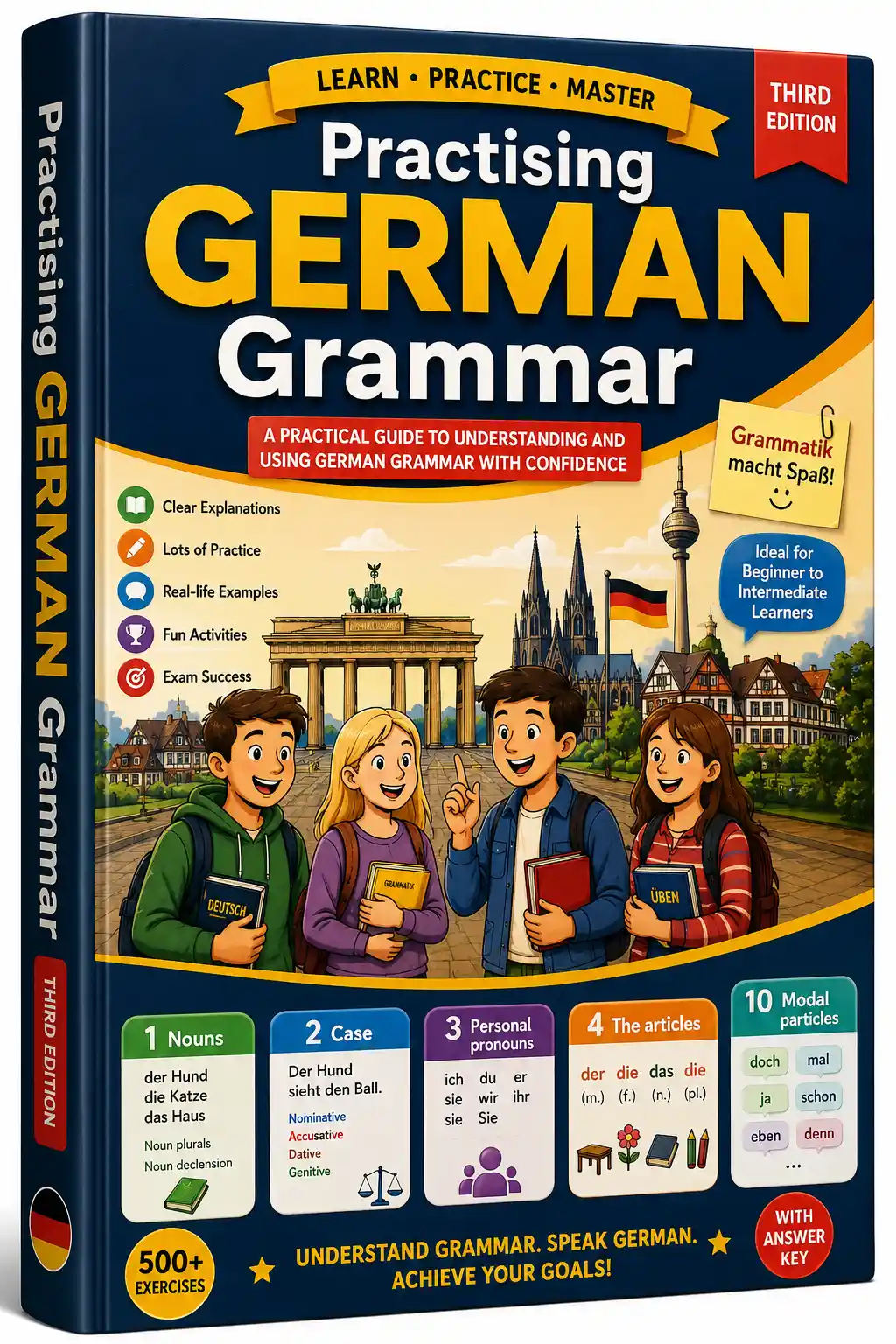
Practicing German Grammar Book 📚 – A Practical Guide to Improving German Grammar
Practicing German Grammar Book 📚 can be a valuable resource for learners who want to understand German grammar and use it more confidently in everyday communication. German grammar includes important topics such as articles, cases, verb conjugation, sentence structure, prepositions, and adjective endings. Regular practice can make these concepts easier to understand and remember.
Why Practice German Grammar?
Grammar provides the structure needed to create clear and correct sentences. Simply memorizing vocabulary is not enough to communicate effectively. Learners also need to understand how words work together in a sentence.
A Practicing German Grammar Book 📚 can help students work through grammar topics step by step. Instead of trying to learn every rule at once, learners can focus on one concept, complete exercises, review mistakes, and then move to the next topic.
Start With Essential Grammar
Beginners should first learn basic sentence structures, personal pronouns, common verbs, and German articles such as der, die, das, ein, and eine. These fundamentals provide a strong foundation for more advanced grammar.
For example, practice simple sentences such as “Ich lerne Deutsch,” “Sie liest ein Buch,” and “Wir wohnen in Berlin.” Repeating similar structures helps learners recognize German word order and verb placement.
Practice the German Cases
The four German cases—Nominative, Accusative, Dative, and Genitive—are essential for understanding how nouns and articles change within sentences. They may seem difficult at first, but regular exercises can make them much easier.
A useful approach is to practice one case at a time with short sentences. Create examples using familiar vocabulary and gradually introduce more complex sentence structures.
Learn From Your Mistakes
Mistakes are an important part of learning German. When you answer an exercise incorrectly, do not simply look at the correct answer and move on. Take a moment to understand why your answer was wrong.
The Practicing German Grammar Book 📚 approach works best when learners actively review their errors. Keeping a small grammar notebook can also help you record difficult rules, common mistakes, and useful examples.
Make Grammar Part of Your Daily Routine
Consistent practice is more effective than occasional long study sessions. Try spending 15–30 minutes each day working on German grammar. Combine exercises with reading, listening, writing, and speaking practice.
For example, after studying a grammar rule, write five original sentences using it. Then read the sentences aloud. This connects grammar knowledge with real communication.
Who Can Benefit From It?
A Practicing German Grammar Book 📚 can be useful for beginners, intermediate learners, students, travelers, and anyone preparing for German-language courses or examinations. Learners at different levels can use grammar exercises to strengthen weak areas and improve accuracy.
Final Thoughts
German grammar becomes easier when you practice regularly and study in manageable steps. A Practicing German Grammar Book 📚 can provide structured exercises that help learners understand grammar, identify mistakes, and build confidence. With patience, repetition, and practical sentence practice, German grammar can become a natural part of your language-learning journey.